Search

Content

Follow Us

Drop Down MenusCSS Drop Down MenuPure CSS Dropdown Menu

Search This Blog

0 Comments

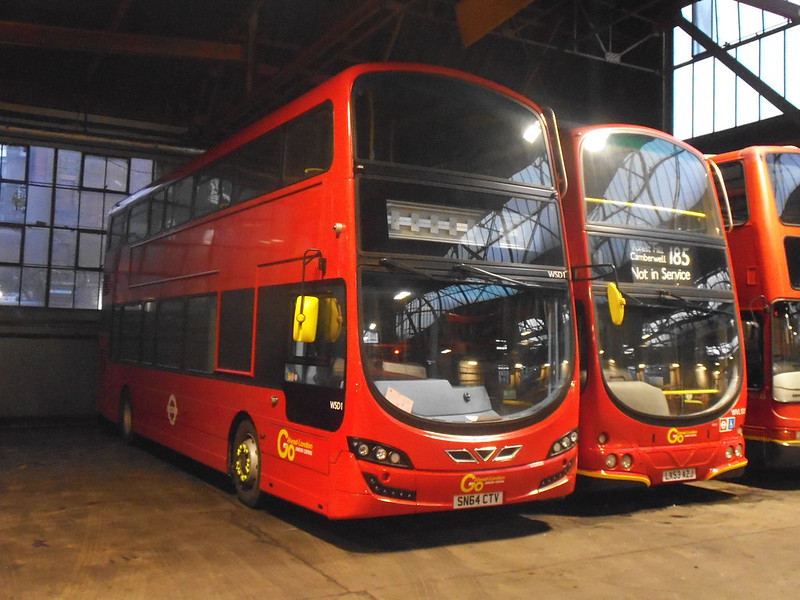
Go Ahead London Camberwell Garage [Q]...WSD1 SN64 CTV

London has a new vehicle in WSD1 SN64 CTV a Wrightbus Gemini 3 mounted to an integral Chassis, fitted with a 5 litre Mercedes engine, but of course, that's too much to utter in one mouthful, so lets just stick to calling in the 'Streetdeck' as advertised on Wrightbus' website. The vehicle almost slipped underneath the radar, if not for someone who reported it running around the Camberwell area after being delivered on the 9th of February. Here for extensive trials against its Volvo counterpart 'V6' another Wrightbus bodied Gemini 3, it will be allocated duties on the 12 (which could of been guessed) and the 45.


At present it awaits blinds and an Oyster card machine, before being commissioned into service here at Camberwell garage. Visually it is identical to its counter part with the only obvious give-away being the fact it is liveried in Go Ahead London colours. This 10 ton beast, well 10,839kgs is the first and second of its kind in London, if you're the pedantic sort, you'd say Arriva's DW411 LJ11 AEB technically comes first, and as I was told today, mechanically, is not much indifferent to the NRMs currently whizzing up and down the streets of London today. Although I do admit it is quite worrying seeing a modern day double decker with a weight of just under 11 tons, I must say the thing feels as steady as any other Wright product and definitely represents one of the many positives brought forth with the 'Streets Ahead' project which sparked this dramatic need for weight reduction on the manufacturer's vehicles.

A thanks must go out to the guys and girls at this very large base, although its not everyday you are told an E400 is the best bus in terms of reliability and that a Volvo B9TL is awful, which was quite odd to hear, with the engineering manager, quoting the former Mandela Way batch as 'dream' machines, which  I reluctantly had to agree with...On a day to day basis, the garage manages vehicles from all aspects within the company's fleet, so its always a pleasure to visit...I think this is visit number three!

Although the garage was opened in 1914, it did not operate a single bus service for much over 5 years when it was requisitioned for the war. However when it did start to operate, it became one of the largest garages in London, the mammoth base was used to carry out body overhauls in 1940s, however in that said year, it was severely damaged following a bomb attack during the war. Following the attack, 13 vehicles were seriously damaged while four were completely destroyed. A write up of the garage can be read below.

The garage was promptly repaired, however in early 1950s the garage underwent a modernisation programme which is sounds funny to say considering the 1950s was so many moons ago. However the programme included the reconstruction of the welfare and operational block, with the addition of a new extended parking area which greatly increased capacity of the garage. The new and improved facilities incorporated a new pit and workshop which also took on the duties of heavy maintenance for the Walworth Garage ironically situated across the road from the base. The changes took the the capacity of the garage to a respectable 350 buses.

Despite its mammoth size, the allocation steadily decreased over the years as many routes were shifted out, until the closure of Walworth garage in 1985. This saw the allocation of vehicles rise back up to 142, although a shadow of the amount it did operate in the 1950s, which was close enough to 200 buses.

For a bit of trivia, the garage held three Leyland Titans, that were fitted with electronic blinds on an experimental basis. The vehicles were used on night bus standby duties. A selection of the photos taken today can be viewed below. 


Go Ahead London Pointer
Go Ahead London PVL302 PJ02 RFX
Go Ahead London WHY7 LX57 CLZ
Go Ahead London PVL86 W486 WGH
Go Ahead London LDP260 SN53 KXY
The forecourt of Camberwell Bus Garage
Go Ahead London LDP206 SN51 UAY
Go Ahead London PVL338 PJ52 LWT
Read more »
12 Comments

Abellio London Beddington Cross [BC]...New MMCs for the 109

A visit to Abellio London's Beddington Cross garage was in order today, and for one reason only..The garage is home to Abellio London who are the remains of Connex and Travel London who were part of the national express group. We visited this location the last time it gained new buses back in June 2012 and we're back here almost three years later. The new buses come in the shape of the highly applauded Enviro 400 MMC model buses, of which 28 have recently been delivered. The new style Enviro 400s which in actual fact is just a face-lifted E400 (with a lot of 'major' changes) took up service on the recently won 109, which duly passed from Arriva to Abellio London on the eve of 30th of January 2015. 


The new buses, numbered between 2487 & 2513 have been received much praise from drivers and passengers alike with one driver, noting they are have a much smoother ride than the previous models operated, which allows them to accelerate quicker, although in the same breath, he also uttered they have been modified so that their top speed is limited.

The relatively small base was opened at the start of the Millennium in the year 2000 following the unexpected expansion of the unsettled Connex Bus who also ran the Southern and South Eastern Rail franchises at the time. The purpose built garage was built to house the route 3 which was won of London Ceneral in 1999. after a very long stint with the operator. 

The small base is comprised of two storage units as well as a compound which includes a bus wash amongst the other normalities you'd expect in a Bus Garage. From the compound visible, is the Metrobus Croydon Depot which is located literally across the road! That tied up with Arriva Garage TC which is only a short distance away makes for perfect competition across the whole Croydon borough especially at the time when tenders are submitted. 

Although not a purpose built depot, in its own right, the company Abellio, since taking over Travel London, who themselves took over the below-par Connex operation, have gone a long way to somewhat turning it into a base fit for a purpose, which is to win, sustain and retain work, this has become evident in the recent tender wins which has seen 455 and T33 won in recent years and more recently the 201 as well as the S3. The Route 109 is the latest of many to transfer here and without any further descriptive text, all the photos from the visit are placed below.

Abellio London E400 MMC YY64 TZA
Abellio London 8820
One of the three sheds that makes up the Abellio Beddington Cross Depot
Abellio London 8831 YY64 YJN
Withdrawn Abellio 8016 BX04 DMO
Abellio London 8438
Another view inside the shed
Abellio London 8528 YX59 BYW
Abellio London 8502 LJ56 ONO
Abellio London  8505 LJ56 ONS
Abellio London 9066 & 8504 LJ56 ONR
Outside the storage facility
Abellio London 8524 YX59 BYS

Abellio London 8473 LF06 YRJ

Abellio London 9030 BX55 XMC
Abellio London 9025 BX55 XLW
Key Facts to note about Beddington Garage
  • Opened in 2000
  • Holds just over 100 Buses
  • Opened primarily to hold the route 3 that was won in 1999
  • Comprised of two separate units 
Read more »
3 Comments

Route 487: South Harrow to Willesden Junction (Timelapse Video)


Route 487 runs between South Harrow and Willesden Junction, serving Alperton, Park Royal, Acton and Harlesden in the process.

The route is operated by Metroline from Alperton Bus Garage (ON) using Enviro200 (DE) buses. The route is 9 miles long and has a Peak Vehicle Requirement (PVR) of 9.

Metroline DE1668 YX09 AEY having just completed a trip from South Harrow whilst working the 487

Read more »
0 Comments

Special Guest Post: Looking at former London buses in Norfolk

We once again welcome Kieran Smith, author of Norwichbuses Blog, to write us a special guest post. This time he will be exploring the former London buses which have ended up in Norfolk.

Norfolk operators have long been subject to acquiring former London buses. Dominant operator, First (and it's NBC predecessor Eastern Counties), is renowned for being possibly the bottom of the First cascade system. In this post I will be sharing my own pictures of former London buses in their new life here in Norfolk.
Both Sanders and Anglianbus have taken on large batches of former Menzies and Metrobus Scania N94UB Omnicities. Sanders currently have nine of the type whilst Anglianbus operate five of the type. For exact details, fleetlists for all the operators mentioned in this post are available from my blog completely free of charge. These can be found here.
Since the Stagecoach takeover of Norfolk Green at the beginning of 2014 a number of new buses have been transferred into the fleet to meet new requirements for school contracts and to standardise the mechanical aspects of the fleet. Along with Alexander Dennis Enviro300s transferred from Stagecoach South, a batch of 2002 and 2003 registered Alexander ALX400 bodied Dennis Tridents have been drafted in from the London operation after their use at the commonwealth games in Glasgow earlier in the year. These bus operate alongside two similar models, 17605/17606 LV52HHP/R which were acquired from Stagecoach London before the takeover.
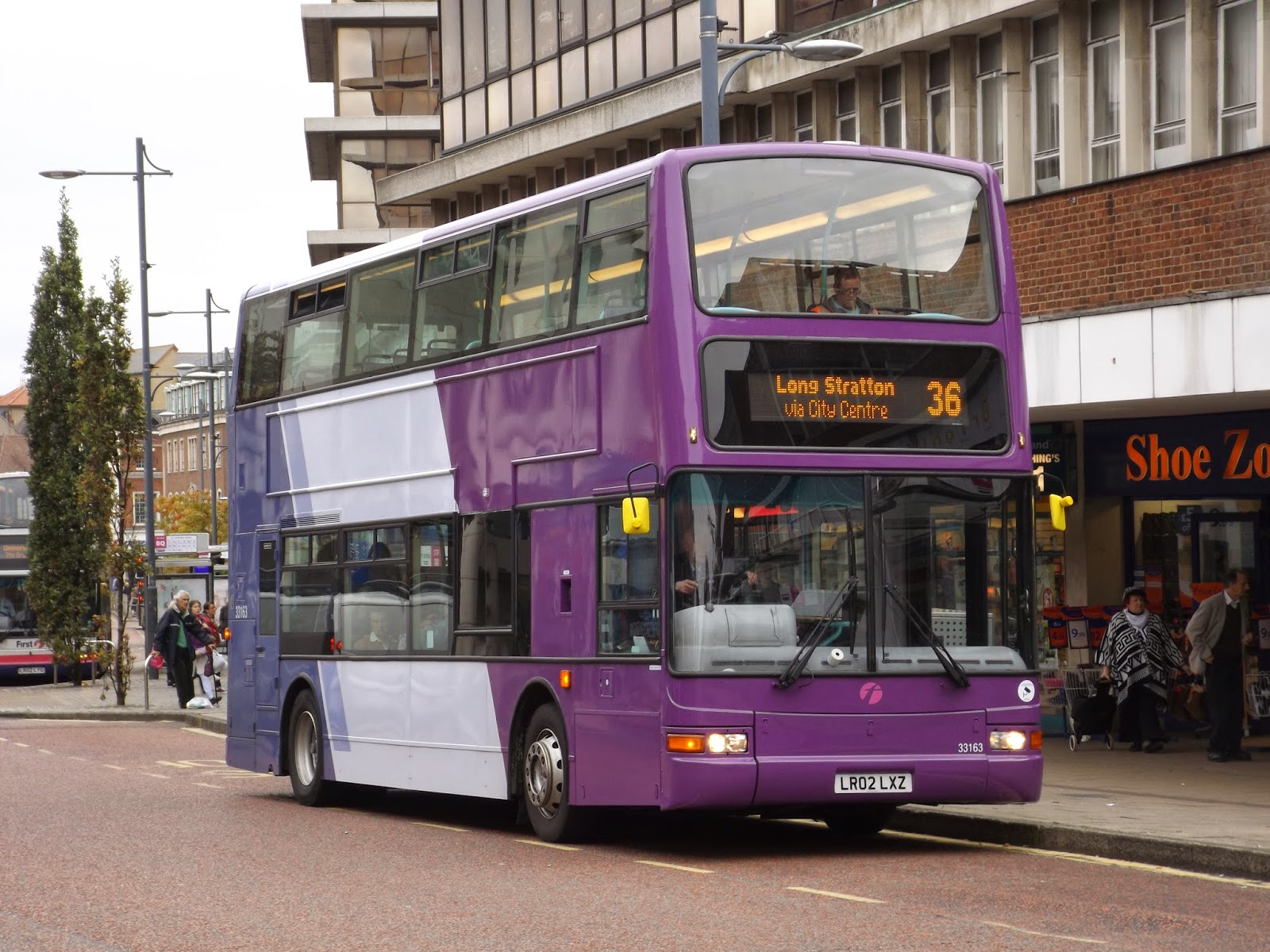
Former London Plaxton President bodied Volvo B7TLs and Dennis Tridents are also popular. Dominant operator First operate around sixty of the type transferred from London from 2010 onwards. The fleet currently operate on the "Norwich Network" and are all in the process of being repainted into the colours of their respective route. The above photograph depicts Dennis Trident/Plaxton President 33003 in its new Purple Line guise. In previous years Go-Ahead owned Konectbus were transferred Volvo based V301/3/7LGC for use as relief, backup and school buses. These were replaced by former Brighton and Hove East Lancs Lolynes, which were replaced this year by former London Central Wright Eclipse Gemini bodied Volvo B7TLs.
Thetford-based Coach Services have taken on three Volvo B7TL based Plaxton Presidents from London Central, in the shape of X509/47/89EGK respectively.
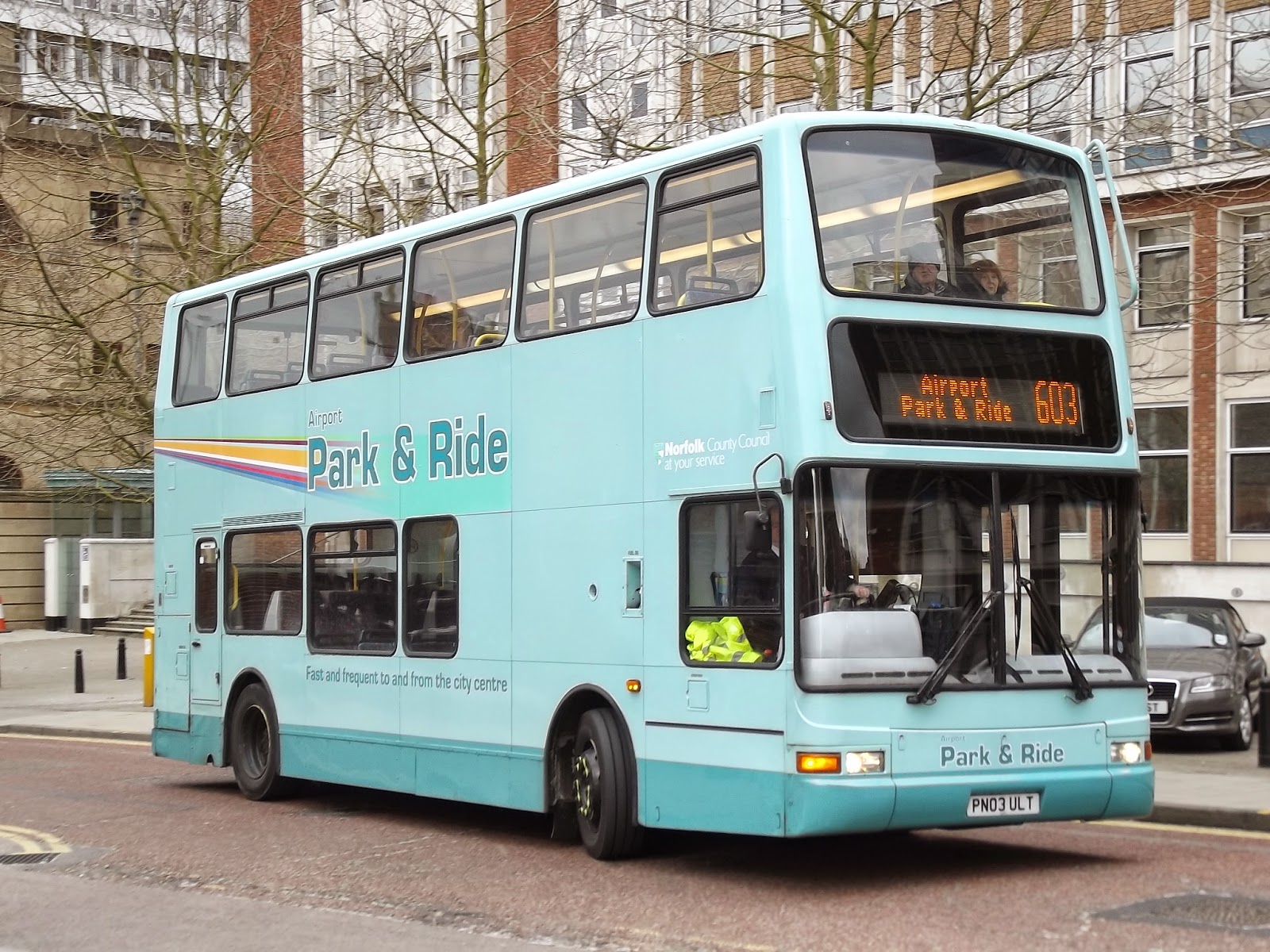
Currently operating 14 Transbus Trident/President buses on park and ride services is Norfolk County Council owned Norse Commercial Services who took on the type in 2010 with the contract renewal. The batch in concern are former Go-Ahead London Central PDL class motors on PN03UL* registrations. Unfortunately, PN03ULX was burnt to a crisp a few years ago and was unable to be recovered.
That's it from me here on The Circle of London Bus Blog. It's been an absolute pleasure to write for you and I sincerely hope you have enjoyed it. To keep with more of my work I've popped some links at the bottom of this post which you may find interesting:

Kieran Smith on Flickr | See Here
Norwichbuses Blog | See Here
Kieran Smith on Twitter | See Here


Read more »
0 Comments

Special Guest Post - Norwich: a parallel universe?

Today we welcome Kieran Smith to the blog who will be writing two special guest features looking at the relations between the London and Norwich bus scene. Kieran already runs his own blog for his local area, Norwichbuses Blog. To head over and check it out, follow this link.

Norwich – A parallel Universe?

I never have been a regular visitor to London, however, this year I found myself the area twice within one month. From this, I realised how different the London bus scene is to the comparably mundane happenings here in Norwich.
Norwich is served by three of the “big groups”, with Stagecoach’s Norfolk Green running in and out of Norwich up to every 30 minutes, First holding the dominance in the city and Go-Ahead’s Anglianbus and Konectbus subsidiaries holding a network of both city and county services. Along with this, independent Sanders Coaches hold a strong network out to North Norfolk with smaller independents running once a week and once a day services in to Norwich.  All in all there are just under 90 different services operating throughout the week. Most services run every twenty to thirty minutes, with a few fifteen minute frequencies. The most high profile route is First’s Blue Line 25 and 26 services, operating with a combined frequency of 8 minutes. To me, this sounds quite hectic; at least I thought that until my visits to London.

Is out of date an understatement?
With buses running up to every 3 minutes across a network of well over 1,000 services I was baffled at how not one person seemed lost and was struggling to find their bus. In Norwich, you couldn't count on your hands how many people there are wandering along Castle Meadow (One of the main bus boarding points in the city) attempting to find their bus, yet in London everybody seems to know what they are doing. I soon began to realise the reason behind this is how organised the bus infrastructure and information is; timetables in every stand, clear maps available and well organised and labelled stops. A number of stops in the Norwich suburbs have no or very out of date stop information, yet on an incomparably larger network decent information is somehow achieved. At a stop on a popular retail park a few miles east of the city centre, the stop information is now five years out of date, showing two services which now have not operated since the evening of September 2012.
Are revolutionary ideas such as NB4L tempting people
onto buses?
One of the busy stopping points for Norwich buses
The quality of the buses in London is also so much better than here in Norwich. In London, the Borismaster, Wright Gemini range and Optare products constantly being sourced for operators are clearly tempting passengers onto the buses, yet in Norwich, First (Norwich’s dominant operator) other than six new Wright Streetlite 10.8m DF buses new this month, the operator has seen no new vehicles since summer 2011 being delivered to the Norwich depots. So are Londoner’s tempted onto the buses as a result of their revolutionary technology and modern look? This point made me again realise just how different London’s attitude to bus travel is. In Norwich there is a pretty poor look onto the buses, their cleanliness and reliability. People hate them. Yet when speaking to somebody who recently moved to Norwich from East London, they could not have spoken more positively about the buses there. She told me she was shocked at how frequent her local service in Norwich operated and how old the bus operating it was; this particular route runs every 20 minutes and is operated by 2001-2002 registered Plaxton President bodied Dennis Tridents and Volvo B7TLs cascaded from London.
At the beginning of this year, the local authorities launched an Oyster style travel top up card called “Holdall”. The intention was to roll it out across all Norwich operators, yet with no operators wanting to jump on board it is only now used as a pre-pay method on council contracted Park and Ride services. On the subject of park and ride, nine of the buses owned by the council operating from three of the six sites are former London Transbus Presidents. If their attitude was to source newer buses for the services, would more people be willing to use the services – hence reducing congestion and pollution in the city centre streets?
All in all, the point of this article is to show how London’s excellent attitude towards the bus system has lead to such a positive and well organised structure. If we had this same attitude towards public transport in Norwich, would we have higher patronage?
Read more »
2 Comments

Route 7: East Acton to Oxford Circus (Timelapse Video)


Route 7 runs between East Acton and Oxford Circus, running parallel to the A404 (Westway), serving Hammersmith Hospital, Ladbroke Grove and Paddington in the process.

The Route is operated by Metroline from Perivale West Bus Garage (PA) using Volvo Wright Gemini 3 Hybrids (VWH's). The route is 7 miles long and has a Peak Vehicle Requirement (PVR) of 19. The Oxford Circus to Russell Square branch has now been removed, leaving 4 free buses from the batch of 23 VWH's. Some of these spare buses are now found mainly on Route 297.


Read more »
4 Comments

Metroline Refurbishment Centre Part 1 [Preview]

On a small estate in the Buckinghamshire countryside is a bus refurbishment centre owned by Metroline who opened the facility in 2013. It was adapted from the success of the company's CELF centre which opened 6 years prior in 2007. At present the centre is receiving an influx of buses, namely vehicles from the batch TE1715-1751 which are being prepped for their uptake on the retained 282 and newly won 482 which will operate from G. The ongoing refurbishment of the SELs for the conversion of 79 and 297 is also nonchalantly taking place here too.


The purpose of the centre opening was to significantly reduce the cost and time it takes to refurbish a bus in order to get the bus back in to revenue as soon as possible Typically the company would either send their vehicles to the Hants & Dorset Trim in Eastleigh which would only be after a slot had been booked, a process that can take months to finalise, or the Rowan Telmac trim in Coventry for which a low loader would be required. Another benefit of having a centre as such is that it reduces the risk of mistakes as everything is foreseen by the man who opened the centre, who I upon speaking to said he "anticipated great things for the centre, and other operators as also keen to utilise the base in the near future. Join us as we add another exciting series to the blog.

Metroline TE1735 SN09 CFK & TE1717 SN09 CDX
Read more »
1 Comments

The Wrightbus Gemini 3


Arriving at the Expo with about an hour to spare, it was all smiles at the Wright camp, who two weeks prior had unveiled their updated Gemini 3 design, a design I was most impressed with. The face-lifted model sees Wright move away from the rounded 'Nokia' design, to a more sleek and sharper looking vehicle, which simply looks fantastic. Other than the obvious, one of the more noticeable features of the vehicle is the smaller grill, which is said to be designed in a manner as such to allow all operators to be able to fit their logo on their products, without a compromise of size.The wrap around windscreen now ensures that there are no driver blind spots, somewhat increasing the safety of the vehicle. The larger blind box along with the reshaping of the unit makes it's accessibility slightly easier too.

From the nearside angle is very hard to spot that the windows are still the shallow ones, specified on the previous Gemini 3 which is by no means called the Gemini 2.5 or 2.75 or any other silly name but they more in proportion with the bodywork of the vehicle, something I had to force my self to get use to with the previous model. Following suit with other manufacturers, the traditional sixties gasket style windows option has been dropped in favour of a new type of bonded window which is set to save operators a few pennies if damaged. It was explained to myself that the previous Gemini 3 model was simply a stop gap in preparation for the new wave of Euro 6 buses and that it was never intended to be a long term solution, not that there was ever a problem in the first place..!

Immediately noticeable with the lower saloon is the airy and spacious interior, although I'll reserve my judgement till I see one delivered to TFL's intricate specification. A few things have been adjusted such as the pitching of the seats which all together make it a more comfortable vehicle to travel on, and one does not have to be particularly choosy in where he or she sits in order to have a comfortable journey. The lighting has also been altered, a smaller strip of LED bulb have been supplied, which spells the end of intrusive lighting and dazzled eyes. The engine bay has also been altered, although only slightly, which increases the height by 1mm, making it a tad more difficult to see out of the rear window contrary to previous Gemini models.The isle has also been slightly widened to allow ease of movement not that Britain is not the fattest European country!

The upper deck has a very upmarket appeal to which probably is exaggerated by the lighting and shallow windows, which create a very tranquil environment, instantly noticeable is the lack of opening windows, with just two which are adjacent to one another. The room line appears to be much higher than before despite the vehicle being the same height as the previous model, erasing concerns over whether one would be able to walk comfortably upstairs, I mean I'm 6'3 and I had no problems what so ever. My only point of concern would be the size of the rear upper deck window, it seems to have shrunk in size even in comparison to the previous Gemini 3 but that's no major flaw.

The rear portion has also been altered to accommodate for the larger engine tray which ultimately results in a smaller rear window. In addition to this, the black masking has also had a change in shape, although I suspect that is more to do with aesthetics more than anything.


My Rating: 8/10 - I like the vehicle at lot, I really do, although one thing I would suggest would be to add rear blind box level lights as well as get rid of some of the black masking, its a bit excessive in my opinion but I guess that's why I'm an enthusiast and not the one who designs these things. Join us throughout the week as we review all of the new types presented at the European Bus Expo in Birmingham this year.
Read more »

Total Pageviews

Recent Comments

Recent Comments Widget

recent posts

Contact Us

Name

Email *

Message *

© The Circle of London Blog 2015

Followers